How to rank and choose a civil litigation attorney in the Netherlands
On this page
What does ranking litigation attorneys mean in the Netherlands?
Ranking litigation attorneys in the Netherlands is the process of comparing licensed Dutch lawyers (advocaten) on factors such as courtroom experience, track record, reputation, and fees. This comparison helps clients identify the advocaat who is best suited to handle their civil litigation matter. The Netherlands has roughly 18,000 registered advocates, so a structured ranking approach saves time and reduces risk.
Unlike in common-law countries such as England, where barristers and solicitors have separate roles, Dutch advocaten handle both advisory and courtroom work. As a result, a single attorney manages your case from the first letter to the final hearing. For international businesses and expats, this difference is worth knowing before you start comparing candidates.
We frequently advise international clients on selecting litigation counsel in the Netherlands. Based on that experience, the factors below are the ones that matter most in practice.
Why does courtroom experience matter most?
Courtroom experience in civiele procedure (civil litigation) is the single most important factor when ranking a Dutch litigation attorney. Not every advocaat appears in court regularly. Many Dutch lawyers focus on advisory work and rarely attend hearings. Therefore, you should ask how often the attorney has appeared before a rechtbank (district court) or gerechtshof (court of appeal) in the past two years.
Unlike in the United States, where jury trials shape how lawyers present evidence, Dutch civil procedures are primarily written. Judges base their decisions on the parties' briefs (processtukken). The oral hearing (mondelinge behandeling) is shorter and more focused. In practice, this means that strong legal writing skills are just as valuable as spoken advocacy.
Attorneys with years of active litigation experience have dealt with procedural objections, interim measures, and appeal deadlines. That hands-on knowledge helps avoid costly mistakes. For instance, missing a single procedural deadline can result in a default judgment against your side.
How should you assess an attorney's track record?
A track record in civil litigation shows how consistently an attorney delivers results. You should ask about recent outcomes in cases similar to yours, especially cases where the attorney represented the plaintiff (eiser) or the defendant (gedaagde) in a comparable role.
Unlike in England, where court judgments are routinely published under party names, many Dutch judgments are anonymized on rechtspraak.nl. As a result, verifying outcomes can be more difficult. In practice, this means you should ask the attorney directly for examples of comparable cases and their results. A credible attorney will be able to describe outcomes without disclosing confidential details.
We frequently handle disputes involving breach of contract, debt collection, and preliminary relief proceedings (kort geding). From that experience, we know that a strong track record in one area does not automatically translate to another. Always check that the attorney's results match the type of dispute you face.
What role does specialization play?
Specialization is a key differentiator when ranking Dutch litigation attorneys. A lawyer who focuses on verbintenissenrecht (law of obligations) and procesrecht (procedural law) will typically outperform a generalist in a complex court case. Some attorneys specialize further in areas such as arbitration (arbitrage), construction disputes, or intellectual property litigation.
Unlike in Germany, where lawyers can obtain a formal Fachanwalt title in a recognized specialty, the Netherlands does not have a statutory specialization system for advocaten. However, the Dutch Bar Association (Nederlandse Orde van Advocaten) does maintain a register of recognized practice areas. Some attorneys also hold quality marks from specialist associations such as the Vereniging van Incasso- en Procesrecht Advocaten (VIPA).
In practice, this means you should ask about the attorney's focus area and the percentage of their caseload devoted to litigation. An attorney who spends most of their time on transactions or regulatory advice may not be the right fit for a contested court case.
How important are communication and reputation?
Clear communication between attorney and client is a factor that clients often underestimate. Under Rule 8 of the Gedragsregels 2018 (Rules of Professional Conduct), a Dutch advocaat must keep the client informed about the progress of the case. This includes updating you on deadlines, court dates, and strategic choices.
Reputation within the Dutch legal community also matters. Judges, opposing counsel, and colleagues form views about an attorney's reliability and professionalism. An attorney known for well-prepared briefs and fair dealing will often achieve better outcomes than one who relies on aggressive tactics alone.
Unlike in the United States, where lawyer advertising and client reviews are widespread, Dutch attorneys traditionally rely on referrals and peer recognition. Online reviews exist, but they carry less weight than a recommendation from another lawyer or a former client. For international clients, asking your home-country lawyer for a referral to a trusted Dutch litigation attorney is often the most effective approach.
What should you know about fees and costs?
Most Dutch litigation attorneys charge an hourly rate (uurtarief). Rates typically range from EUR 150 to EUR 450 per hour, depending on the attorney's experience and the size of the firm. Under Rule 17 of the Gedragsregels 2018, the attorney must provide a clear fee arrangement in writing before the work begins. This written confirmation is called an opdrachtbevestiging (engagement letter).
In addition to attorney fees, you should budget for court fees (griffierecht) and bailiff costs (deurwaarderskosten). Court fees depend on the claim amount and the type of court. For a district court claim of EUR 100,000, the court fee for a legal entity is currently around EUR 2,889. Bailiff costs for serving the summons (dagvaarding) typically range from EUR 100 to EUR 150.
Unlike in England, where the losing party can be ordered to pay the winner's actual legal costs, the Dutch system applies a fixed-fee schedule called the liquidatietarief. This schedule awards only a fraction of the actual costs. In practice, this means that even if you win, you will recover only part of your attorney fees from the other side. Also consider the costs of litigation in the Netherlands when planning your budget.
How do you verify bar registration and professional conduct?
Every advocaat in the Netherlands must be registered with the Dutch Bar Association (Nederlandse Orde van Advocaten). The Bar maintains a public register at advocatenorde.nl. You can check an attorney's bar membership, years of admission, practice areas, and any disciplinary history. If a lawyer does not appear in this register, they are not licensed to represent you in court.
The Dutch Bar also enforces the Gedragsregels 2018 and the Advocatenwet (Lawyers Act). Complaints about professional conduct are handled by the local bar president (deken). Serious cases are referred to the Disciplinary Board (Raad van Discipline). In practice, this means that Dutch attorneys are subject to active supervision, and you can file a complaint if the attorney fails to meet professional standards.
For international businesses, a useful first step is to verify the attorney's listing in the Bar register and ask about their experience with cross-border disputes. We frequently advise clients to request the attorney's opdrachtbevestiging before the first billable hour, so that fees, scope, and communication arrangements are documented from the start.
What about legal aid for litigation in the Netherlands?
Legal aid (gesubsidieerde rechtsbijstand) is available in the Netherlands for individuals who cannot afford a lawyer. The Legal Aid Board (Raad voor Rechtsbijstand) determines eligibility based on income and assets. If you qualify, the Board assigns a registered attorney and covers most of the fees. You pay only a personal contribution (eigen bijdrage), which varies by income bracket.
Legal aid covers civil litigation, including cases before the subdistrict court (kantonrechter) and the district court. However, not all attorneys accept legal-aid cases (toevoegingszaken). When ranking attorneys, check whether the ones on your shortlist participate in the legal-aid system, if that is relevant to your situation.
Unlike in England, where legal aid for civil cases has been heavily restricted since the Legal Aid, Sentencing and Punishment of Offenders Act 2012, the Dutch system still provides relatively broad access to funded representation. For international clients who do not qualify for legal aid, the fee transparency rules described above offer protection against unexpected costs.
List of top litigation attorneys in the Netherlands
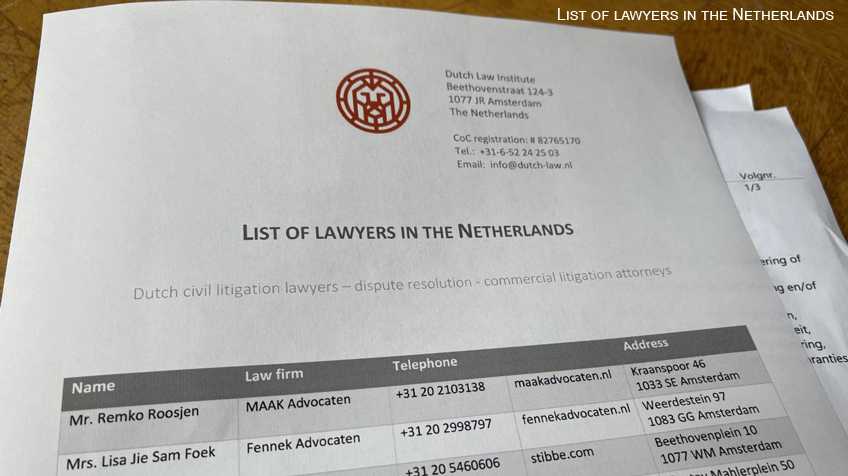
The Dutch Law Institute has compiled a list of top litigation attorneys in the Netherlands. This list ranks attorneys based on the factors discussed above, including courtroom experience, track record, specialization, and professional conduct. You can download the list as a PDF for your reference.
Download the list of top lawyers in the Netherlands (PDF)